
A New Look at Faculty Pay at America’s Top Universities
This Edgeworth Insight illustrates how a regression model can be used to compare average pay between groups, conditional on the regression’s explanatory factors. We show how a between-group difference in average pay, based on a regression with explanatory factors, can differ substantially from the simple unconditional average pay difference between groups.
Last month a table listing the 20 universities with the highest average total compensation for full-time faculty was circulated on social media. The list, based on 2023 data compiled by the American Association of University Professors (AAUP), included 18 private universities. Below we present an updated list, also based on AAUP data, showing the ten universities with the highest average salaries for full professors in 2025, along with their ranking according to U.S. News & World Report (U.S. News). It is worth noting that nine out of the ten universities in Table 1 are private. Across all analyzed universities, with no additional controls, average full professor salary at private universities is 8.5% higher than at public universities (a statistically significant difference).
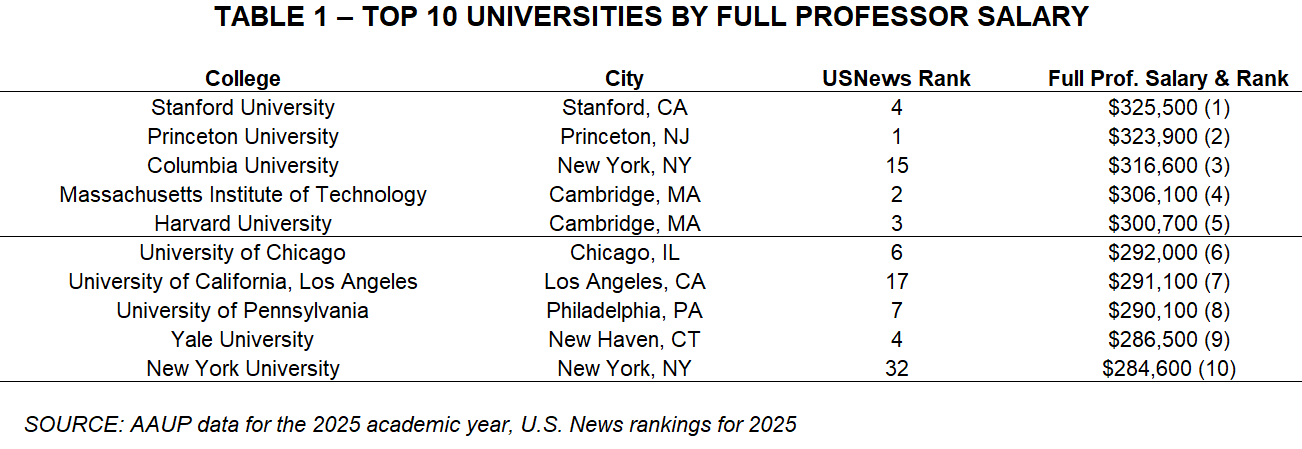
Perhaps, not surprisingly, the concentration of highly accomplished professors at elite schools results in a strong correlation between a university’s average full professor salary and the U.S. News ranking. Seven of the U.S. News highest ranked universities are included in Table 1, including five Ivy League schools. In addition, the five universities with the highest average professor salaries are all located in metro areas with some of the highest cost-of-living in the U.S. (Including San Jose and New York, the areas with the highest average cost-of-living).[1] Prestigious schools, especially those in high cost-of-living metro areas, tend to pay the highest full professor salaries.
We analyzed the top 200 universities according to the U.S. News rankings for 2025, and were able to match AAUP salary data to 173 of the universities, because not all schools appear in the AAUP data in every year. We matched schools to OEWS data based on the labor market area in which the school is located for our cost-of-living measure. Using this matched data set, we estimate a regression model that accounts for the school’s U.S. News ranking, cost-of-living in the labor market area where the school is located, and whether the school is public or private.[2]
The regression model allows for the possibility that the pay-U.S. News rank relationship is not simply log-linear and shows that the pay-U.S. News rank gradient is significantly steeper within the top 50 schools than among schools outside the top 50. Each one position increase within the top 50 U.S. News ranking is associated with a 0.86% increase in average full professor salaries, and a one position increase outside the top 50 is associated with a 0.23% average salary increase. These estimated differences are significant at the 1% level.
For our cost-of-living proxy, we also find that each 1% increase in the local area’s average pay for management jobs is associated with a 0.32% increase in a full professor’s pay, which is also significant at the 1% level. For average pay differences between public and private schools, our regression model shows that professors’ salaries are significantly lower, on average, in private universities, relative to public universities once we control for their U.S. News ranking and local area cost-of-living. We find that public universities pay full professor salaries that are 5.6% higher, on average, than in private universities conditional on these observed factors. This estimated difference is also significant at the 1% level.
With just college ranking, local area cost-of-living, and public/private status as controls, our regression accounts for 78% of the variation in full professor pay across universities.[3] While other factors could be included to better account for the variation in average pay across universities, such as the distribution of professors across fields of study and full professors’ average experience, our simple model illustrates that unconditional comparisons of average pay differences across universities can be misleading.
Finally, we also identify which universities appear to pay the highest average full professor salaries conditional on these factors. The top 20 universities based on full professors’ regression-adjusted salaries (pay regression residuals) are listed below.

The University of Alabama pays the highest regression-adjusted salaries to full professors even though its nominal average salary was the 76th highest of the 173 universities in our study. In other words, if all schools had the same U.S. News ranking, faced the same cost-of-living, and had the same public/private status, University of Alabama professors would earn the highest salaries, on average. Texas Tech University, the University of California - Santa Cruz, Missouri University of Science and Technology, and the University of Miami are the other schools with the five highest regression-adjusted salaries. Out of the top 20 universities in the regression-adjusted rankings shown above, 12 are public universities.
New York University is the only university that appears in the top 10 across Table 1 and Table 2; it was 10th in Table 1 and 6th in regression-adjusted salaries. Columbia University (the only Ivy League school in Table 2) and the University of California - Los Angeles are other universities that appeared in both Tables. Among other universities with high U.S. News rankings that appear in Table 1, Princeton University falls to 30th in regression-adjusted salary rankings; Stanford University falls to 51st; Massachusetts Institute of Technology falls to 56th; and Harvard University falls to 64th.
There are, of course, many legitimate reasons why average compensation will differ across universities after accounting for the factors in our model. For example, because faculty in STEM fields earn higher salaries, on average, than faculty in other fields, schools with higher shares of STEM faculty will tend to pay higher average salaries, all else equal.[4]
Many differences in faculty composition across universities are not accounted for in our model, and non-salary compensation may differ among universities. In addition, non-salary compensation may differ, on average, between public and private universities, so our regression results do not necessarily imply that professors’ total compensation differs significantly between public and private schools. Because of these possible differences, our model does not indicate whether professors are relatively underpaid or overpaid at any of these universities.
Even with these limitations, our regression shows that it is misleading to compare unconditional average faculty salaries across schools. Average professor salaries at elite universities in high cost-of-living areas are expected to be higher than at moderately-ranked universities in areas with a much lower cost-of-living. School quality and location differences completely offset the average unconditional public-private difference in professors’ salaries. Our regression instead shows that professor salaries are significantly lower, on average, in private universities than in comparable public universities. Finally, our regression can be used to assess which universities would pay the highest salaries to professors if all schools had the same U.S. News ranking and operated in areas with the same cost-of-living.
CITATIONS
[1] Other differences in the composition of faculty could account for the variation in regression-adjusted faculty pay. In addition, our proxy for cost-of-living differences may not fully reflect actual differences across areas because of between-area differences in the composition of employees in management occupations.
[2] The regression we estimate is similar to the pay regressions used to account for individual pay differences among employees at the same university in pay equity studies and class action discrimination lawsuits. Individual pay regression models would account for individual characteristics such as rank, labor market experience, length of time in position, publications, citations, teaching evaluations, department/field of study and other relevant characteristics.
[3] We proxy cost-of-living with average salaries for management employees in each school’s metro area. Among the five U.S. News highest ranked universities, Trenton-Princeton is the metro area with the lowest average salary for management employees, but it is still a relatively high cost-of-living area and is 8th out of 387 metro areas in the U.S.
[4] Cost-of-living is proxied with the average pay for management occupations in the school’s local area based on May 2025 Occupational Employment and Wage Statistics (OEWS) data. We use management occupations rather than all professional occupations because many schools in our study are in “college towns,” and the average salaries for professional occupations in OEWS data, which includes these professors, will largely reflect average faculty pay in the local school(s) in these areas.
Experts
 Partner
 Aryan TotawatSenior Consultant